Oh, this isn't a very dignified way to enter the new year, with a strained falsetto and a Beck-lite ironic-funk rhythm track. Outta the Bag isn't nearly as clever as Cale seems to think, seeing as he chose it lead off his weirdly paced blackAcetate. But is it enjoyable?
To me it certainly is. The adventurous and restless vocal melody is very appealing once one adjusts to the multitracked falsettos in Cale's timeworn voice. The different layers of instrumental funk are pure ear candy, the instrumental drop out a minute and three quarters in is awesome, and so is the monotone rhythm guitar chord chop that starts at 2m40s - like one of Neil Young's infamous one-note guitar solos, allowing the rest of the song to rotate around it. And the pure daffiness - bird chirps, the "the birdies sing: woo hoo hoo" coda - is quite welcome, fitting as it does with the album's goal of puncturing inflated perceptions of Cale as artiste.
The live version loses a lot of the fun but gains a little live energy. I don't know if it's a worthwhile trade.
The lyrics aren't half bad either, though not revelatory. It's Cale's take on "I Heard It Through the Grapevine" - delivering the bad news to an unfaithful partner, maybe. The words are spiky and passive aggressive and a good mixture of vague and specific. There are some evocative lyrics. I can't complain!
In particular, I really like the way it continues a two-decade chain of references. More on this next time.
Friday, January 2, 2009
Outta The Bag

Tuesday, November 25, 2008
Year of the Patriot
The aesthetics of desperation really work for me. That said, I have another obscurity for you, from the recently reissued Words for the Dying documentary - and its tragic nature (and the story gets worse) isn't its only notable aspect.
As usual, Hans scooped me on the money quote, but, hey, I'm not proud:
There was a Russian double bass player that Brian Eno and I ran into when recording ‘Words For The Dying’. He had gigantic hands. He had hands like spades. I remember before I met him I was listening to the radio in New York and they played his record. He used to play Paganini on the bass. I got to Moscow and I asked, “Do you know this guy?” And someone says “Yeah he’s in the next building. He works next door!” I told Brian about him and I said, “You gotta hear this guy play. He is just amazing! He plays the double bass but he plays Paganini on this thing!”
So we set it up and arranged it and it was really sad. I mean the guy walked in a tuxedo and sat himself up and brought all the armors with him and set the armors up on chairs behind him in a semi circle and he stood in the middle and he started playing the bass. We noticed there was something wrong and also we noticed that the people that worked with him were making fun of him. What was happening was the guy had a disease called lupus [ed. note: um, no, though quite possibly Marfan Syndrome.] and his whole body was changing. You know the bones kind of crumble and they swell up. And his hands were gigantic. Very efficient in playing what he was doing but his face had altered. And he had this sort of distorted flat face. And it was horrible the way they were making fun of him.
It's an uncomfortable scene - Cale and Eno are obviously rather horrified by the situation, and they're both remarkably condescending - but what emerges from it is an outline of a remarkable piece. Despite the project, the lyrics don't appear to be Dylan Thomas, but Cale - "I'm buying my enemies to sell my friends. I'm buying my friends to sell my enemies. In the year of the patriot, the traitor is king and the genie's out of the bottle." OK, somewhat rough, but it's the start of something.
When I first saw the documentary - on a hard-won VHS tape - I was struck by the piece and was saddened that it was reduced to this little scrap. It's hard to see what more they could have done with it, to be sure, but what's there is evocative. I guess I should be grateful to have it. More...
Friday, November 21, 2008
Sudden Death
Assassinations and societal upheaval in unspecified third world (?) countries are the order of the day in "Sudden Death," and no wonder. It's one of Cale's most outright political songs, and yet there's really no moral judgment happening: his most disgusted moment is when he seems to dismiss a murderous mob as amateurs. It's hard to get any sense of the narrator. The narrative voice is wry, detached, and more pitying than anything else. The result is an ambiguous, chiaroscuro lyric and one of the more haunting final tracks of any of Cale's albums.
What's most notable about the song is the way an astonishingly reportorial lyric is rendered elegantly in Cale's vocal. A line like, "UPI and Reuters were the first ones to the phone," does not deserve to work as well as it does - but then again I didn't parse the words for months of listening to it. There's a fatigue to the lyric that maybe captures the feeling of the mid-70s as well as anything else I've heard.
The slow and bassy music works well to match the lyric, though the echoed piano split at the wide edges of the stereo picture end up feeling unnervingly disco-ish. Lots of great viola and string work in general (not to mention bassoon!). It's a little turgid, I admit - I vacillate a bit on really how good it is. But it is certainly worth hearing.
Though Cale was not to record again for four years, 1979's Sabotage/Live picked up not far from where this track left off. Shame he never did this one live during those shows.
Tuesday, November 18, 2008
Don't Pretend
So, see if you believe that this exists. This is a self-helpish track, just this far from Max Powers in its lyrics. Our friend John urges us to carpe the diem in very blunt terms, with some seemingly obvious inversions of what is meant ("the physical world will transcend", "life is the dream that you must wake"). It lacks any sort of particular angle that would make it particular to a specific scenario, but is sort of generic and all-encompassing. Only the coda gives it any hint of an interesting spin: "You'll be a big man someday / just starting with today," which might be interpreted to mean that it's directed at the young.
But why does it feel like a Violent Femmes song? The vocal melody, the weird and American word choices, the occasional lapses into anachronism ("troubles must needs come"), the pulsing/stabbing instrumental (except here it's piano)? It's so blatant you'd think it was written by Gordon Gano.
Which indeed it was, appearing as it did on GG's strange 2002 quasi-self-tribute album Hitting the Ground. Elsewhere on the bizarre my-new-songs-performed-by-my-heroes album, Lou Reed got a cowriting credit on the much earthier "Catch 'Em in the Act", but Cale just plays the notes and sings the words as written. Gano observes, "I wrote 'Don't Pretend' trying to play like John Cale. Instead of me imitating him on the record, you get the real John Cale playing the song they way I envisioned it. How cool is that?"
It sounds like an interesting sort of hall of mirrors, Cale performing Gano (writing like Cale) like Gano, but really it just ends up being insulting to both of them. My favorite part of the whole weird scene is the credulous reviewers suggesting it would fit on Paris 1919. Thank God Cale was about to come out of his period of collaborative drift with 5 Tracks.
Friday, August 29, 2008
Dance of the Seven Veils
 Today's my favorite feast day in the old Catholic calendar: the beheading of St. John the Baptist. It so happens that our man Cale has the perfect song for it, too - a live dramatization featuring Judy Nylon on vocals. Dance of the Seven Veils is a somewhat cheesy recasting of the very cheesy Oscar Wilde interpretation of the biblical Salome story. I find a little girl childishly toddling around the room and then asking for the head of the great (loony) ascetic to be a lot more appealing dramatically than Wilde's psychosexual obsessive.
Cale & Nylon & Co. thankfully do not take the material overly seriously. Judy chews the scenery nearly as well as her partner - as morningside posted over here, Salome is recast as a sassy New York Girl. Nylon's narration proceeds through flirtation ("to tell the truth..."), lust ("take his lips and..."), murder ("I want the head of the Baptist!"), and denouement ("'Now get her.'")
The instrumentals are really appealing, building and building circularly in a very post-rock way before crashing into that coda. The coda, the part that actually features singing, seems a little rough/incomplete, but it's an appropriate conclusion to the piece. ANYWAY, I wish there were more and better recordings of the Cale band(s) of this period - they're among the tightest and rapport-ful of any of Cale's bands. The performances on Sabotage are better than anything on Cowgirls, but not by that much.
Somehow I suspect that there was a visual component to this. Damn shame we don't have a record of that.
Saturday, August 23, 2008
Chickenshit
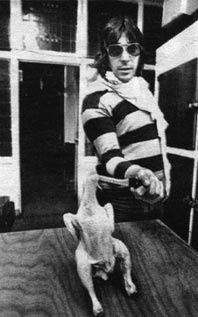 About the lede the other day...
I'm stealing from Hans here, who did the work of typing in the following from Cale's maddening, intriguing, invariably sordid quasisemihemidemiauto- auto- auto- autobiography What's Welsh For Zen?:
One day on the tour, we were driving back to London and I said to the tour manager, 'I want to get a live chicken.' We had bought a meat cleaver in Germany and it gave me an idea. I told him to stop at a farmhouse and buy a chicken, but put in a box so that nobody else in the band would know. However, he came out of the farmhouse holding the squawking chicken by its legs. All the way back to the Portobello Hotel everybody in the band was asking, 'What's he gonna do with the fucking chicken? You're not going to hurt it, right?'
The gig was at Croydon. I had the chicken killed backstage and put on a wooden platter with a handle. I told the roadie: 'When I get into the second verse of Heartbreak Hotel, slide it out to me on the platter.' I already had the meat cleaver stashed on stage. The guys in front were slam-dancing, bopping and swaying. All those punks with their leather and chains, pushing everybody because they had taken too much speed. So I thought, try a little voodoo! I am singing, 'We could be so lonely,' swinging the chicken around by its feet, nobody in the audience knowing it was dead, 'we could be so –' Twhok! I decapitated it and threw the body into the slam dancers at the front of the stage, and I threw the head past them. It landed in somebody's Pimm's. Everyone looked totally disgusted. The bass player was about to vomit and all the musicians moved away from me. Even the slam dancers stopped in mid-slam. It was the most effective show-stopper I ever came up with.And then he goes and throws a hilariously awful dramatization on the even more hilariously titled 'Animal Justice' EP:
"Hi, my name is Arthur- and I quit!"Not an episode to be proud of (as Cale admitted, not quite convincingly). I'm not tolerant of cruelty to animals. Why, then, is this episode such a guilty pleasure to me as a fan?
Chickenshit!
"You know he said something about a taking a feather home for his wife, you know for a hat that she was making."
"I don't- I don't know what he's gonna do with that chicken..."
"He said he's not gonna hurt it, so, so it's OK."
"Alright, fair enough."
Ain't nobody gonna waste my time
Nobody tells me what's his and what's mine
Break down a window, break down a door
Don't wanna listen to you no more
"I don't know man, I mean, it's uh, it's kinda, I'm getting kinda nervous."
"Starting to get worried?"
"I'm not qualified to..."
Go on by my houses, you tear down the wall
Darling don't like it, better stay at home
I need her trouble like a hole in the head
Get out yer gun and use it instead
"Checking out, need my things? Room 42, please."
"You alright, John? You're not gonna hurt it, are ya?"
Wasting your time, telling me what to do
Take it or leave it or put it down
Get out of the way, don't bring it down
Gotta be, gotta be put out in the ground
Chickenshit! Chickenshit! Chickenshit!
"Oh, oh my god."
"Did you, did you see what he did, he did?!" *retching noises*
"Oh, I don't believe he did it. I mean, I was standing right there, I saw the whole thing with my own eyes. I never thought he'd do something like that. I mean, what do you think? It was so unreal!"
Nobody gonna push me around
Nobody gonna put words in my mouth
Listen to no one, I don't get my mail
Told me a fool always ends up in jail
"What were you thinking? You said you weren't gonna hurt it!"
"I didn't hurt it, I killed it. Gave it the fucking heave-ho."
*chatter and recriminations*
Photo by Ronald van Kaam.
More...
Thursday, August 21, 2008
Heartbreak Hotel
This is the song that killed a chicken, and that's hardly the most remarkable thing about it. That was in 1977, in Cale's mid-post-Glam-ish-whateverthehell period. He was doing polo shirts before the Talking Heads, I'm saying. Back then, in those innocent days of good friends, fast women, lots of drugs, and no studio recordings whatsoever, Heartbreak Hotel was pretty much camp, as it was from its debut in the Cale arrangement on June 1, 1974 (yeah, that's the name of the album it's on, too - and we all know what happened on May 30). He would change the arrangement a bit over the years, but through the end of the Seventies it was pretty much the same old bloated parody.
Something like this, from as late as 1981 (gawsh, that's Andy Summers! yet another Cale almost-producee):
And as over-the-top as Cale was through most of that period, and even as genuinely threatening as he could sound, Heartbreak Hotel never really seemed more than a bit of good fun - something to lurch through with some high-concept stage mischief.
But somewhere between playing mit der Polizei and coming out of his lost years, in the less innocent days of good friends, fast women, lots of drugs, and possibly too many studio recordings, somewhere around the time he seems to have hit bottom in '83/'84, he started playing it on solo piano. And no more was this man kidding around.
You can hit this version as being equally over the top, less pleasurable, pretentious, laughably melodramatic without the sense of self-satire that earlier versions had. Hell, audience members start laughing - albeit nervously, this not being what they were used to.
But whatever you think of it, it's hitting an entirely different set of emotional targets now. Like Cale's other piano in extremis songs - Fear and Guts and Waiting for the Man - there's a potent mixture of emotions here. I don't know if it would stand as well on its own without exposure to the Presley version, Cale's earlier and later versions, etc. - but you who haven't heard any of it before can tell me, eh? But IMO it's the definitive Cale version of the song - hell, the most affecting arrangement of the Axton/Durden/Presley song around, says I - and it's not really represented on any albums (John Cale Comes Alive is as close as you get).
But in a radio studio late at night in the winter of 1984, in the middle of an almost unbelievably shambolic performance/forty minutes of weirdness, Cale essayed the unbeatable performance. Anger, resignation, hatred, fear- everything surfaces in it like tongues of flame in a fire. The ending even shut up the annoying radio personality (who, to be fair, was probably panicking at the disaster on his hands). Hear it, if you haven't. Listen again if you have.
Cale gradually gentrified the arrangement, removed the screaming and scenery chewing. The new arrangement, different spins of which can be heard on Circus Live and Fragments of a Rainy Season, is fine - moving in its way, more emotionally resonant than the original - I say this lovingly - wankfest. But it's almost background music now, and doesn't grab you by the balls. I don't think it's coincidence that it's paired with Style It Takes both places.
Subtlety has its virtues, and you can't live like Cale was living in 1984 for very long. But thank God we have recordings of Cale at rock bottom. More...


